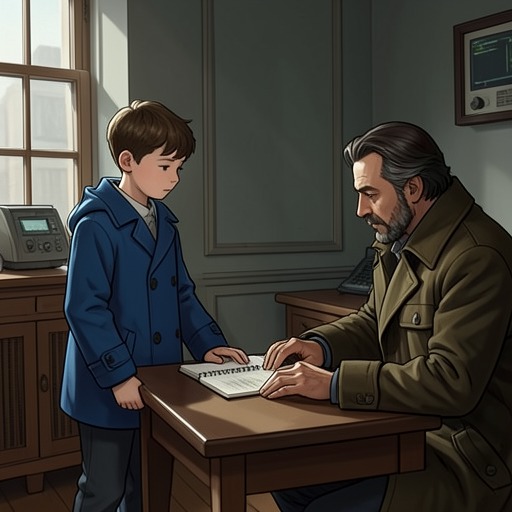
Honest work and self-reliance agreement
Black BoxThe Honest work and self-reliance agreement is Michel Sommo’s condition for helping Boaz Brandstetter without turning aid into an entitlement. It joins financial support to personal responsibility: Boaz retains meaningful choice, but is expected to act uprightly, save, and live by his own labor. The arrangement is neither a simple refusal of money nor an unconditional offer; its force lies in the boundary it draws between assistance that sustains a person and money that, in Michel’s judgment, would excuse him from becoming one.
Principle and Terms
In a letter dated 16 April 1976, Michel tells Boaz that he respects their agreement: Boaz may do what he likes so long as he does it uprightly and in the sweat of his brow. The permission matters as much as the demand. Michel is not claiming the right to dictate Boaz’s occupation or compel him to return home; he is insisting that choice carry the obligation of honest work.
Michel’s offer of money follows that principle. He sends postal orders for IL 3,000 and says he will consider further sums if Boaz identifies a positive purpose. Repayment with interest is acceptable, but not immediately: Michel imagines Boaz repaying years later, when he is established in good deeds and in material terms. In the meantime, he urges Boaz to keep saving. Support is available, but it is framed as help toward a future of self-reliance, not as a replacement for it.
Freedom, Pride, and a Place at Home
Michel repeatedly connects the agreement to Boaz’s refusal to come home. In a later letter, he explains that the money is Boaz’s father’s and invites him to Jerusalem for the Sabbath, where the family will explain what they know about it. He and Boaz’s mother and sister also offer him a room: an extension is planned with two additional rooms, one intended for Boaz, though Michel stresses that the family can make space for him even before it is built. The offer counters the idea that independence requires rejecting every form of family support.
At the same time, Michel warns that Boaz’s pride is leading him astray. He presents restraint—not the wasteful defense of pride—as part of adulthood, applying the point both to Boaz’s separation from home and to his stubbornness toward his mother. The agreement therefore governs more than wages or repayment. It is also Michel’s attempt to keep Boaz’s self-determination from hardening into estrangement.
Work Rather Than Charity
The principle becomes concrete when Boaz stays in the backyard shed of Bruno and Janine Fuchs. Michel agrees that Boaz may remain there if the Fuchs family accepts him, but says he will pay them rent from Boaz’s father’s reparation money. Boaz is not to live there for nothing: Michel rejects the roles of beggar and welfare provider. The payment secures a place to stay while preserving, in Michel’s view, a measure of dignity and obligation.
Michel’s own youth supplies a pointed comparison. After arriving in Paris from Algeria with his parents, he studied at the lycée by day and worked evenings as an apprentice to an uncle who was an X-ray technician. When that uncle refused him a loan for a Larousse dictionary, Michel felt so insulted that he left the job and, after school, took work cleaning stairs. He later admits that at the time he was still a child and stubborn. His story gives the agreement a personal history: he knows both the sting of refused aid and the cost of answering refusal with wounded pride.
The Boundary of Support
The rule is clearest when Boaz proposes that Michel join a Red Sea tourist-boat business. Boaz expects a preliminary investment to be recovered within months. Michel refuses both loans and investment, invoking the principle that one must earn bread by the sweat of one’s brow. He will not finance boats, tourists, or girls with money Boaz did not earn, even when the venture is presented as a business opportunity.
The refusal does not become a rejection of Boaz. After turning down the proposal, Michel makes Boaz and his friend a large meal, takes the family out to the cinema and for ice cream, and remains willing to fund education. He says that if Boaz wants to study, he need only say so; earlier, he had offered to pay for an optics course if Boaz supplied information about it, and had also offered to help arrange Torah and trade studies or work in Jerusalem. The distinction is deliberate: Michel will finance learning and practical support, but not a venture he regards as spending unearned money. The agreement thus makes care conditional in its uses, not absent in its affections.